Satellite Communication Solutions
Satellite communication enables connectivity across geographies where terrestrial networks are absent, unreliable, or economically unviable. By transmitting signals via orbiting satellites, satcom solutions provide coverage across oceans, remote terrain, disaster zones, and underserved regions, serving applications that range from emergency communication and maritime tracking to rural broadband and national security.
Satellite networks operate across multiple orbital regimes — geostationary (GEO), medium earth orbit (MEO), and low earth orbit (LEO) — each offering different trade-offs in coverage, latency, and capacity. GEO satellites provide wide-area coverage from fixed orbital positions and are well-suited for mobile satellite services, emergency communications, broadcast, backhaul, and IoT messaging applications. LEO constellations, operating at much lower altitudes, offer significantly reduced latency and are enabling a new generation of broadband and direct-to-device services. MEO satellites occupy the middle ground, supporting navigation and certain broadband use cases.
Satellite IoT — or Sat-IoT — is one of the fastest-growing segments of the satcom market. While emerging LEO networks are opening new connectivity models, GEO-based satellite IoT continues to play a vital role in mission-critical applications where ubiquitous coverage, network resilience, and operational reliability are essential. These capabilities are increasingly being used for asset tracking, fleet management, agriculture, maritime, and industrial monitoring applications where terrestrial connectivity is impractical.
Looking ahead, satellite communication is converging more closely with terrestrial mobile networks. The integration of non-terrestrial networks (NTN) into 3GPP standards, the growth of direct-to-device satellite services, and the expansion of LEO broadband constellations are all redefining the role of satcom within broader connectivity architectures.
Tejas Networks provides satcom solutions built on end-to-end expertise spanning chipset development, SDR platform design, ground system integration, and large-scale field deployment. The portfolio covers from satellite phones and asset tracking terminals to hub equipment, and network management platforms — supporting a converged architecture designed for mission-critical connectivity across defence, government, maritime, and enterprise environments.

Key Highlights
End-to-End Expertise from Chipset to Deployment
Tejas brings together in-house capabilities spanning chipset design, SDR platform development, ground system integration, and large-scale field deployment — enabling a fully integrated and accountable satcom solution lifecycle.
Indigenous, Secure SDR-Based Architecture
Built on Software Defined Radio technology developed indigenously, the solutions support secure operation with the flexibility to implement both standard and non-standard waveforms across frequency bands — critical for defence and government applications.
Comprehensive Portfolio from Terminal to Hub
Covers the full system stack including satellite phones, asset tracking terminals, hub baseband equipment, gateway systems, network management platforms, and end-user applications — enabling complete ground segment solutions.
Sat-IoT and Mobile Satellite Services Support
Enables real-time asset tracking, two-way messaging, and low-power IoT connectivity over satellite, supporting applications across maritime, rail, defence, and remote infrastructure monitoring.
Multi-Waveform and Multi-Band Flexibility
Supports standard and non-standard waveforms across L-band and S-band, enabling converged network solutions that serve diverse mission profiles within a unified platform architecture.
Proven Large-Scale Deployment Experience
Backed by extensive experience in the installation, commissioning, and operationalization of large-scale Sat-IoT networks, ensuring reliable performance from pilot to national-scale rollout.
Products
NAVDOOT: Two‑Way Mobile Satellite Service Terminal
Two-Way MSS Terminal
SAMRAT: S-Band Satellite Phone
S-Band Satellite Phone
NAVRAIL: Satellite‑Based Locomotive Tracking & Communication Terminal
Two-Way Mobile Satellite Service Terminal
Tarang
L-Band Multichannel Burst Demodulator
Lehar
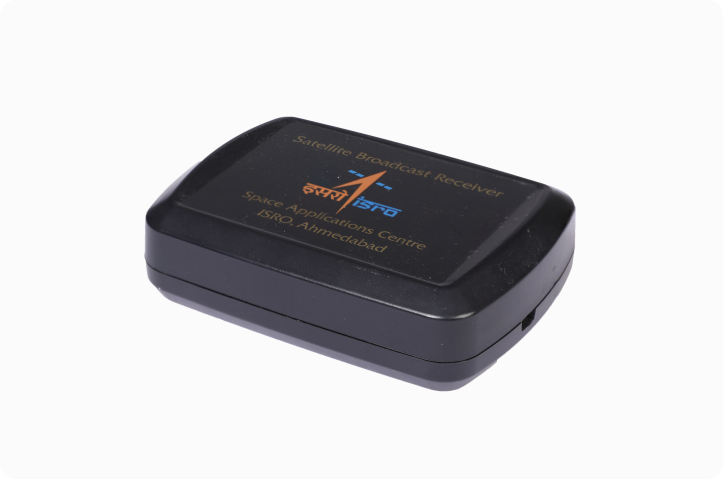
S-Band Broadcast Receiver
Gyandoot
Satellite Receive Only Terminal
Frequently asked questions
What is satellite communication and what role does it play in modern connectivity?
Satellite communication uses orbiting spacecraft to relay signals between ground-based terminals, enabling connectivity across distances and geographies that terrestrial networks cannot efficiently serve. It plays a critical role in extending coverage to remote areas, supporting emergency and disaster response, enabling maritime and aviation connectivity, and providing backhaul for rural and underserved networks. As terrestrial and satellite networks increasingly converge, satcom is also becoming an integral layer within broader mobile and IoT connectivity architectures.
What are the differences between GEO, MEO, and LEO satellite orbits, and how do they affect satcom performance?
Geostationary (GEO) satellites orbit at approximately 36,000 km altitude and remain fixed relative to the earth’s surface, providing stable wide-area coverage suitable for broadcast, backhaul, and messaging services. The trade-off is higher latency due to the signal travel distance. Medium earth orbit (MEO) satellites operate at intermediate altitudes and are used primarily for navigation systems and certain broadband applications. Low earth orbit (LEO) satellites operate at altitudes below 2,000 km, offering significantly lower latency and higher throughput, making them increasingly attractive for broadband and direct-to-device services — though requiring larger constellations to maintain continuous coverage.
What is Satellite IoT (Sat-IoT) and what applications does it enable?
Satellite IoT refers to the use of satellite connectivity to link low-power devices and sensors that operate beyond the reach of terrestrial mobile networks. It enables applications such as asset tracking for vehicles, vessels, and cargo, remote monitoring of pipelines, agriculture, and industrial equipment, fleet management across land and maritime environments, and emergency alerting from isolated locations. Sat-IoT devices are typically designed for low power consumption and infrequent data transmission, making them practical for deployment in remote or resource-constrained environments.
What is Software Defined Radio (SDR) and why is it significant for satellite communication?
Software Defined Radio is an approach to radio system design in which functions traditionally implemented in dedicated hardware — such as modulation, demodulation, filtering, and protocol processing — are instead implemented in software running on programmable hardware platforms. In satellite communication, SDR enables ground terminals and hub systems to support multiple waveforms and frequency bands on a single hardware platform, adapt to new standards or mission requirements through software updates, and reduce the cost and complexity of maintaining diverse satellite system configurations. SDR is particularly valuable in defence and government satcom contexts where waveform flexibility and security are priorities.
How does satellite communication support defence and government connectivity requirements?
Defence and government satcom applications require connectivity that is secure, resilient, and operable in environments where commercial infrastructure may be unavailable or compromised. Satellite communication addresses these requirements by providing independent communication paths that function regardless of terrestrial network status. Indigenous development of satcom hardware and software adds an additional layer of supply chain assurance and security, reducing dependence on foreign components for mission-critical systems. Waveform flexibility through SDR further allows communication systems to be adapted to specific operational requirements.
What is the significance of non-terrestrial networks (NTN) in the evolution of satellite communication?
Non-terrestrial networks represent the formal integration of satellite and aerial communication platforms into mobile network standards, particularly 3GPP standards governing 4G and 5G. This integration allows user devices to connect directly to satellites using standard mobile protocols, extending network coverage without requiring specialised terminal equipment. NTN is expected to play an important role in providing ubiquitous coverage for IoT devices, enabling continuity of service in areas without terrestrial coverage, and supporting hybrid connectivity models that seamlessly combine satellite and terrestrial access.
How are satellite communication networks managed and monitored at scale?
Managing large-scale satellite communication networks requires centralised visibility across geographically dispersed terminals, hub equipment, and satellite links. Network management platforms for satcom must handle terminal provisioning, link monitoring, fault detection, and performance reporting across potentially thousands of endpoints. As Sat-IoT deployments grow in scale — spanning maritime, rail, agriculture, and industrial sectors — automated management and analytics capabilities become essential to maintain operational efficiency and service reliability.