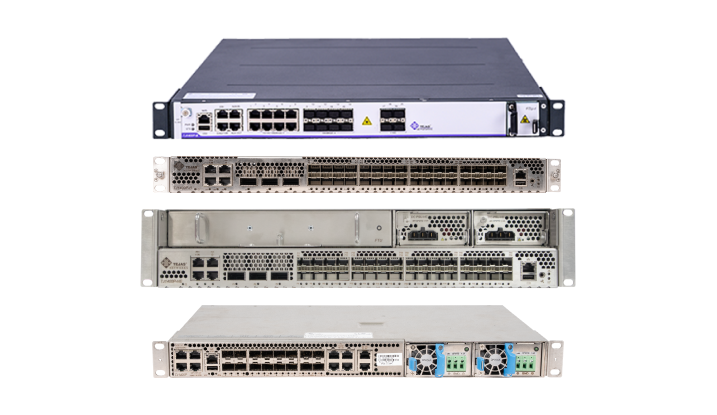
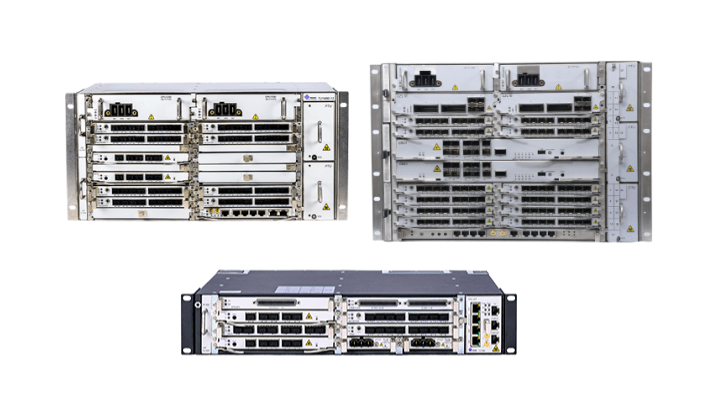
Tejas Networks’ Packet Transport Network solutions deliver high-performance packet switching with a flexible mix of services, supporting Carrier Ethernet, MPLS-TP, and Circuit Emulation across aggregation and multi-service transport deployments.
The portfolio offers multiple platform configurations to address diverse capacity and coverage requirements with support for synchronization, advanced OAM, and resilient protection mechanisms.
Packet Transport Networks (PTN) play a critical role in the modernization of telecom infrastructure, enabling the transition from legacy circuit-switched networks to scalable packet-based architectures. These networks are designed to carry a mix of services, including legacy TDM traffic and modern IP-based services, over a unified transport framework.
While traditional switching and routing networks focus on packet forwarding and control, PTN systems are optimized for deterministic transport, service awareness, and seamless migration from legacy technologies. They provide mechanisms such as circuit emulation and synchronization support, allowing existing services to continue operating even as underlying network architectures evolve.
PTN platforms act as an intermediate layer between access networks and higher-capacity aggregation or core transport systems, providing efficient service aggregation while maintaining strict performance characteristics required by mobile backhaul, enterprise connectivity, and utility networks. This makes them particularly relevant in environments where legacy and next-generation services must coexist.
A key design objective of PTN is to enable gradual network transformation rather than disruptive replacement. By supporting both packet and legacy transport technologies on a common platform, operators can modernize networks incrementally, optimize infrastructure utilization, and minimize service disruption during migration.
Tejas Networks’ PTN solutions are designed to support this transition, enabling scalable, service-aware transport with integrated support for legacy and packet services across access and aggregation layers.
Key Highlights
Seamless Migration from Legacy to Packet Networks Supports transition from TDM and circuit-switched networks to packet-based transport using circuit emulation and multi-service capabilities.
Unified Multi-Service Transport Infrastructure Enables concurrent transport of legacy TDM, Ethernet, and IP services on a unified platform, reducing network complexity and simplifying operations.
Deterministic and Service-Aware Packet Transport Provides predictable performance with QoS, traffic engineering, and synchronization support for critical services such as mobile backhaul.
Synchronization Support Supports technologies such as SyncE and IEEE 1588v2 to ensure accurate timing and synchronization across packet networks.
High Resilience and Rapid Protection Mechanisms Ensures service continuity with fast failover and protection switching, maintaining reliability in legacy and modern services.
Efficient Footprint for Distributed Networks Combines compact form factors with optimized power consumption, making it well suited for deployment across large numbers of access and aggregation locations.
Products
TJ1400P Packet Transport Platform
Compact PTN with advanced Ethernet and MPLS-TP support
What is a Packet Transport Network (PTN) and how is it different from traditional packet networks?
A Packet Transport Network is designed to carry multiple service types, including legacy TDM and modern packet traffic, over a unified infrastructure. Unlike traditional packet networks that focus primarily on data forwarding, PTN emphasizes deterministic performance, service awareness, and support for legacy services during network transitions.
Why are PTN solutions important for network modernization and service continuity?
PTN solutions enable operators to transition from legacy circuit-switched networks to packet-based infrastructure without disrupting existing services. By supporting both legacy and modern services on the same platform, they allow gradual network transformation while maintaining continuity for critical applications.
How does PTN support legacy TDM services over packet networks?
PTN uses circuit emulation techniques to transport TDM services over packet networks while preserving timing and performance characteristics. This allows existing services to continue operating without requiring immediate changes to end systems.
What is circuit emulation and why is it important?
Circuit emulation allows traditional circuit-switched services to be carried over packet networks by replicating the behavior of dedicated circuits. It is critical for maintaining service continuity during network migration.
What is traffic engineering in a packet transport network, and why does it matter?
Traffic engineering refers to how network traffic is directed and distributed across available paths to optimize performance and resource utilization. In PTN, it helps ensure predictable performance for critical services, avoids congestion, and makes efficient use of network capacity—especially important in networks carrying a mix of legacy and packet-based traffic.
How does MPLS‑TP enable deterministic packet transport in PTN networks
MPLS‑TP (Multiprotocol Label Switching – Transport Profile) is a transport-oriented version of MPLS designed for predictable, connection-oriented networking. It provides features such as deterministic paths, strong fault management, and fast protection switching, making it well suited for carrier networks that require high reliability and operational simplicity.
Why is synchronization critical in packet transport networks?
Accurate synchronization is essential for services such as mobile networks, utilities, and industrial systems where precise timing is required. In PTN, synchronization technologies such as SyncE and IEEE 1588v2 ensure that network elements remain time-aligned, enabling proper functioning of applications like cellular handovers, frequency synchronization, and time-sensitive operations in distributed networks.
How does PTN ensure reliable performance for critical services?
PTN solutions combine quality of service (QoS), traffic engineering, and fast protection mechanisms to deliver predictable and resilient performance. This ensures that critical services—such as mobile backhaul and utility networks—maintain consistent performance even under varying network conditions.
Recommended for You
Technology
Success Stories
Southeast Asian Utility Major Selects Tejas solution for Network Infrastructure Modernization and Expansion
Technology
Success Stories
Emerging US Internet Service Provider Chooses Tejas Networks’ TJ1400 UCB for building Future-proof Networks
Technology
Success Stories
State Power Utility Chooses Tejas Solution for Network Modernization
Interested to Explore More and See How Tejas Can Help You?