Converged 4G/5G Mobile Packet Core
The mobile packet core forms the central intelligence layer of a mobile network, responsible for managing user connectivity, session control, data routing, and service delivery across access and transport domains. It ensures that subscriber traffic is authenticated, securely connected, and efficiently routed between radio networks, data networks, and applications.
Historically, mobile core networks were built on dedicated, tightly coupled architectures supporting 2G, 3G, and later 4G EPC systems. With the introduction of 5G, the core network has evolved toward a more modular, service‑based architecture, decoupling control and user plane functions and enabling flexible deployment models. In many deployments, operators are adopting converged 4G/5G core architectures that allow EPC and 5G Core functions to coexist on a unified platform, enabling gradual migration without disrupting existing services. This shift allows operators to deploy core functions centrally or closer to the edge, depending on latency, capacity, and service requirements.
The mobile core plays a critical role in service orchestration and policy control. It enables capabilities such as mobility management, quality of service enforcement, subscriber data management, and traffic steering across distributed network elements. These functions become increasingly important in 5G networks, where diverse services—including enhanced mobile broadband, enterprise connectivity, and low‑latency applications—must be supported on a shared infrastructure.
Modern mobile core architectures are also closely aligned with cloud-native principles, enabling scalable, software-driven deployments using microservices and containerized environments. This allows networks to adapt dynamically to changing traffic patterns and service demands, while supporting continuous evolution toward standalone 5G and edge-based service delivery.
Tejas Networks’ mobile packet core solutions are designed to support this architectural evolution, enabling operators to deploy and manage converged 4G/5G core functions with flexibility, interoperability, and operational efficiency.
Key Highlights

Telco‑Grade Scalability & Performance
Designed for large scale public mobile networks and dense enterprise deployments.

High Availability & Geo‑Redundant Architecture
Built as a carrier‑grade core with 99.999% availability, supporting geo‑redundancy and resilient operations across distributed network environments.

Distributed & Edge‑Ready User Plane
Supports distributed and on‑the‑edge UPF deployments , enabling low‑latency applications and optimized traffic steering for 5G and enterprise use cases.

3GPP Release 17 Compliant Interfaces
Aligned with the 3GPP Release 17 interface specifications, delivering assured compatibility, ecosystem openness, and long‑term investment protection.

Fully Cloud‑Native, Microservices‑Based Architecture
Designed with a cloud‑native, microservices‑driven architecture to enable elastic scaling, faster feature rollout, and simplified lifecycle management.

Converged 4G/5G Core Platform
A single, unified core supporting EPC and 5G Core, enabling seamless 4G/ 5G interworking and smooth evolution to standalone 5G networks.
Products
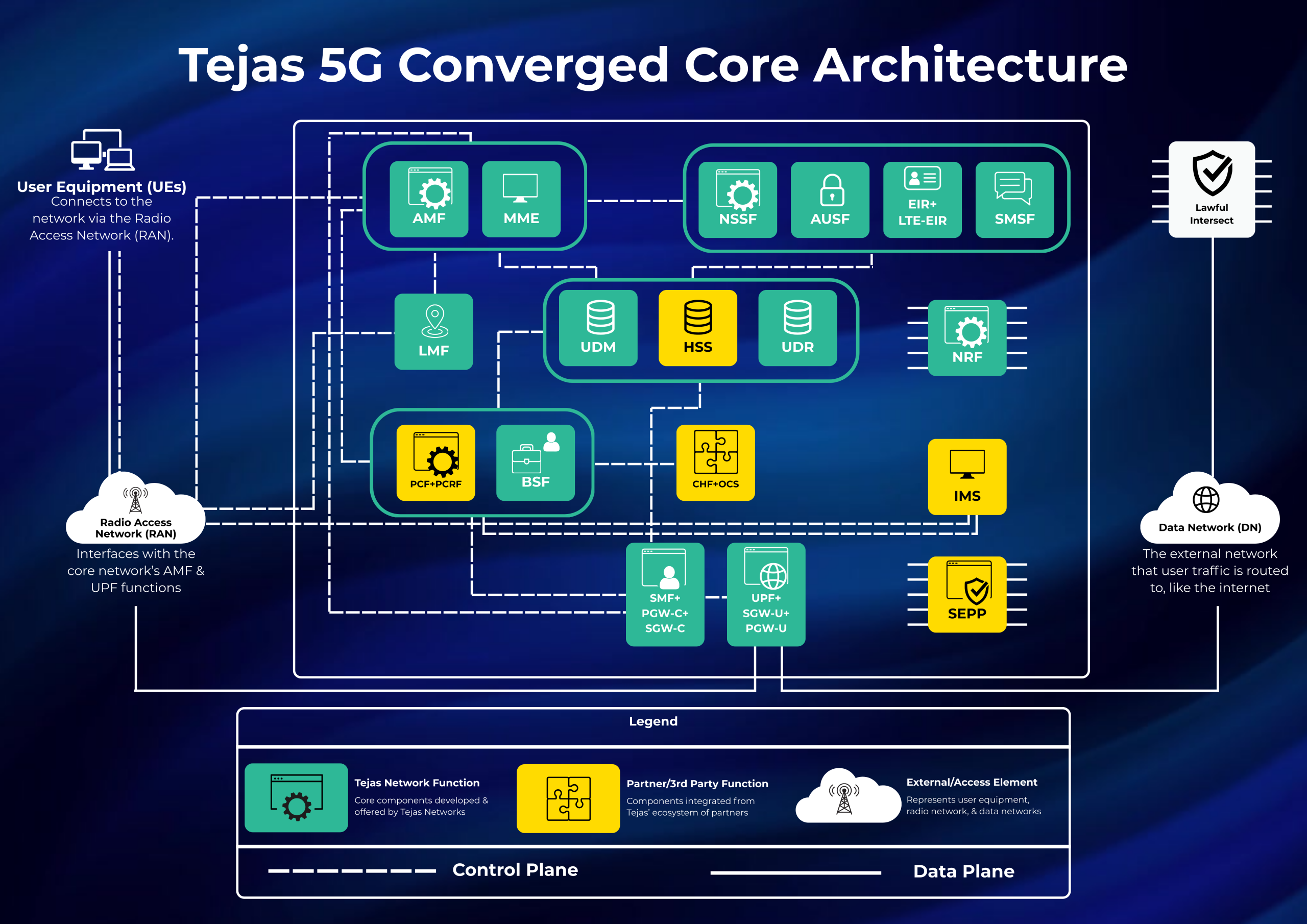
TJ9500
Tejas TJ9500 5G Converged Core is a, cloud-native core network solution that unifies 4G EPC and 5G Core (5GC) functions.
Frequently asked questions
What is the role of the mobile packet core in a cellular network?
The mobile packet core acts as the central control and data management layer of a cellular network. It manages user sessions, mobility, authentication, and data routing between radio access networks and external data networks, ensuring seamless connectivity and service delivery.
How has the mobile core evolved from 4G EPC to 5G Core?
The transition from 4G EPC to 5G Core introduces a more modular, service-based architecture, with separation of control and user plane functions and support for cloud-native deployment models. In practice, many operators are adopting converged 4G/5G core architectures, where EPC and 5G Core functions coexist on a shared platform, enabling gradual migration to standalone 5G while maintaining continuity for existing services.
What is a Service-Based Architecture (SBA) in 5G Core?
Service-based architecture breaks down core network functions into modular services that communicate via standardized APIs. This allows greater flexibility, easier scaling, and faster introduction of new services compared to traditional tightly coupled core architectures.
What is the significance of Control and User Plane Separation (CUPS)?
CUPS separates session control functions from data forwarding functions, allowing independent scaling and flexible placement of each. This enables operators to deploy user plane functions closer to the edge for improved latency and efficiency.
Why is edge deployment of user plane functions important in 5G networks?
Placing user plane functions closer to network edge locations reduces latency and improves performance for applications such as real-time services, enterprise use cases, and edge computing environments.
How does the mobile core enable different types of services in 5G?
The mobile core supports service differentiation through policy control, traffic steering, and network slicing mechanisms. This enables operators to support diverse use cases such as enhanced mobile broadband, enterprise connectivity, and low-latency applications on the same network.
What is network slicing and how is it supported in the core network?
Network slicing allows multiple virtual networks to be created on a shared physical infrastructure, each optimized for a specific service or application. The mobile core manages slice selection, policy enforcement, and resource allocation across these virtual networks.
How does a cloud-native architecture benefit mobile core deployments?
Cloud-native architectures enable scalable, software-driven deployment of core network functions using containers and microservices. This improves resource utilization, simplifies upgrades, and allows faster adaptation to changing traffic and service requirements.
How is a private 5G core different from a public mobile core?
A private 5G core is typically deployed to support a specific enterprise or campus environment, with greater emphasis on local control, security, and low‑latency processing. Unlike public mobile cores that serve large-scale subscriber networks, private cores are often deployed closer to the enterprise environment and can be tailored to specific application and performance requirements.