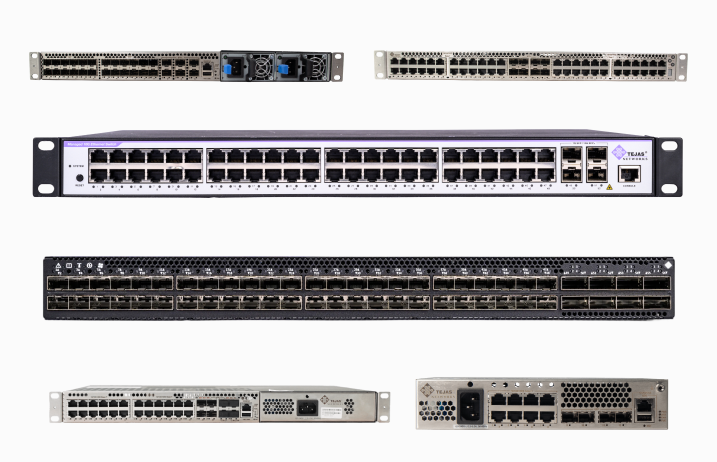
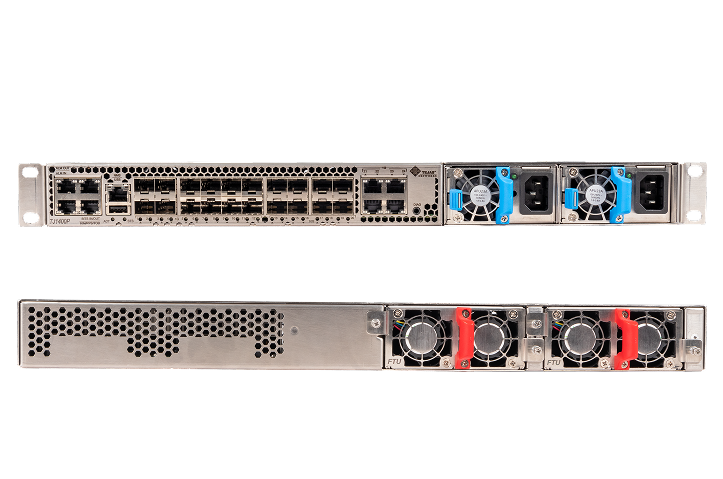
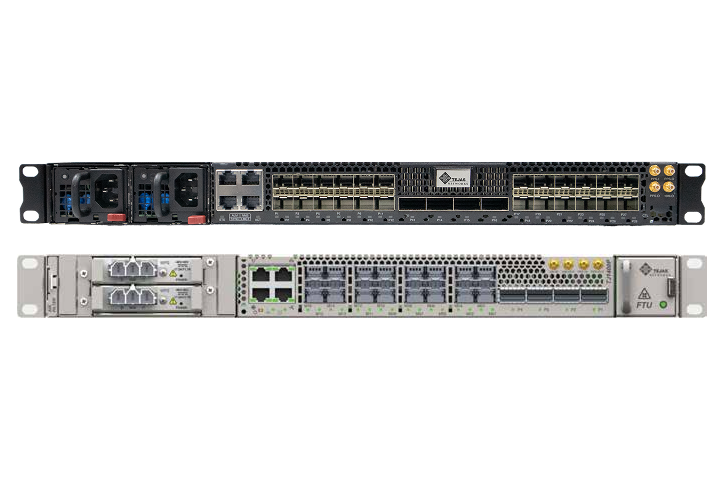
Switching and Routing Solutions
Designed for high-availability environments, each platform supports advanced protection mechanisms and consistent performance. With standards-based protocols, Tejas solutions integrate seamlessly into existing infrastructures — empowering operators to deliver reliable services while optimising network costs and operational efficiency.
Packet switching and routing technologies form the foundation of modern telecom and enterprise networks, enabling efficient data transport across access, aggregation, and core layers. These networks support a wide range of services, from mobile backhaul and broadband access to enterprise connectivity and data center networking.
In packet networks, switching is typically used within local or aggregation domains to forward traffic based on Layer 2 information, while routing operates at Layer 3 to direct traffic across networks using IP addressing. Technologies such as Carrier Ethernet and IP/MPLS networks combine these capabilities, enabling efficient traffic engineering, service differentiation, and scalable service delivery across telecom networks.
While switching and routing operate in the packet domain, optical transport provides the underlying high‑capacity connectivity over fiber. These layers work together in a complementary architecture, with the optical layer enabling efficient data transport and the packet layer providing traffic control, service intelligence, and routing decisions.
The growth of cloud‑native services, distributed data centers, and 5G networks is driving the need for flexible, resilient, and scalable packet transport infrastructures. Looking ahead, switching and routing networks are expected to leverage increased automation, enhanced telemetry, and tighter integration with network control and orchestration systems. This evolution will enable operators to optimize performance, improve operational efficiency, and support emerging services across mobile, enterprise, and cloud environments.
Tejas Networks provides switching and routing solutions designed to deliver scalable packet transport, high performance, and reliable service delivery across access and aggregation network layers.
Key Highlights
Enhanced Carrier Ethernet Features, IP Routing Support
Energy-Efficient Designs with Low Total Cost of Ownership
Small Form Factor Options for Use as Customer Premise Equipment
Complete Range of Ethernet Switches and Routers for Service Provider, Enterprise, Campus and Industrial Networks
Coverage across Port-configurations, Capacities, Feature Scalability
Temperature-Hardened Access Switch Options (-40°C to +65°C)
Frequently asked questions
How should operators design packet networks for 5G and cloud‑driven traffic?
Designing packet networks for 5G and cloud-driven traffic requires a scalable and flexible architecture that can handle high capacity, low latency, and dynamic traffic patterns. Operators typically use a layered or unified approach, combining technologies such as Carrier Ethernet, MPLS, or IP routing depending on network requirements.
Modern networks are increasingly moving toward IP/MPLS or segment‑routing–based architectures for greater scalability and simplified operations. Regardless of the approach, support for synchronization, quality of service, and traffic engineering remains essential to meet the performance demands of 5G and cloud applications.
How are changing traffic patterns impacting packet network design?
Traffic is becoming more distributed and dynamic due to cloud services, edge computing, and data center growth. Networks must efficiently handle both user-facing (north‑south) and data center (east‑west) traffic flows.
What should enterprises consider when selecting switching and routing solutions?
Enterprises should consider scalability, performance, and interoperability, along with deployment constraints such as space, power, and operating environments. Compact, energy‑efficient solutions with flexible deployment options enable efficient rollout across enterprise and edge networks.
What does quality of service (QoS) mean in practical terms?
Quality of service (QoS) refers to the ability of a network to prioritize different types of traffic to ensure consistent performance. For example, real-time applications such as voice and video can be given higher priority over less time-sensitive traffic, helping maintain performance during heavy network usage.
What are the key considerations for building resilient packet networks?
Resilience is achieved through redundancy, fast convergence, and protection mechanisms. Network design must account for failover scenarios and ensure minimal service disruption during faults.
What is traffic engineering in a network, and why does it matter?
Traffic engineering refers to how network traffic is directed across available paths to optimize performance and resource utilization. Instead of following the shortest route, traffic is distributed intelligently to avoid congestion and ensure consistent service quality.
How does switching and routing integrate with optical transport networks?
Switching and routing manage traffic flows in the packet domain, while optical transport provides high‑capacity connectivity over fiber. Together, they form a complementary architecture supporting efficient end‑to‑end network operation.
How are routing approaches such as segment routing influencing packet networks?
Approaches such as segment routing, including SRv6, are evolving traditional IP/MPLS networks by simplifying traffic engineering and improving scalability. These methods reduce reliance on complex control plane mechanisms while enabling more flexible traffic flows.